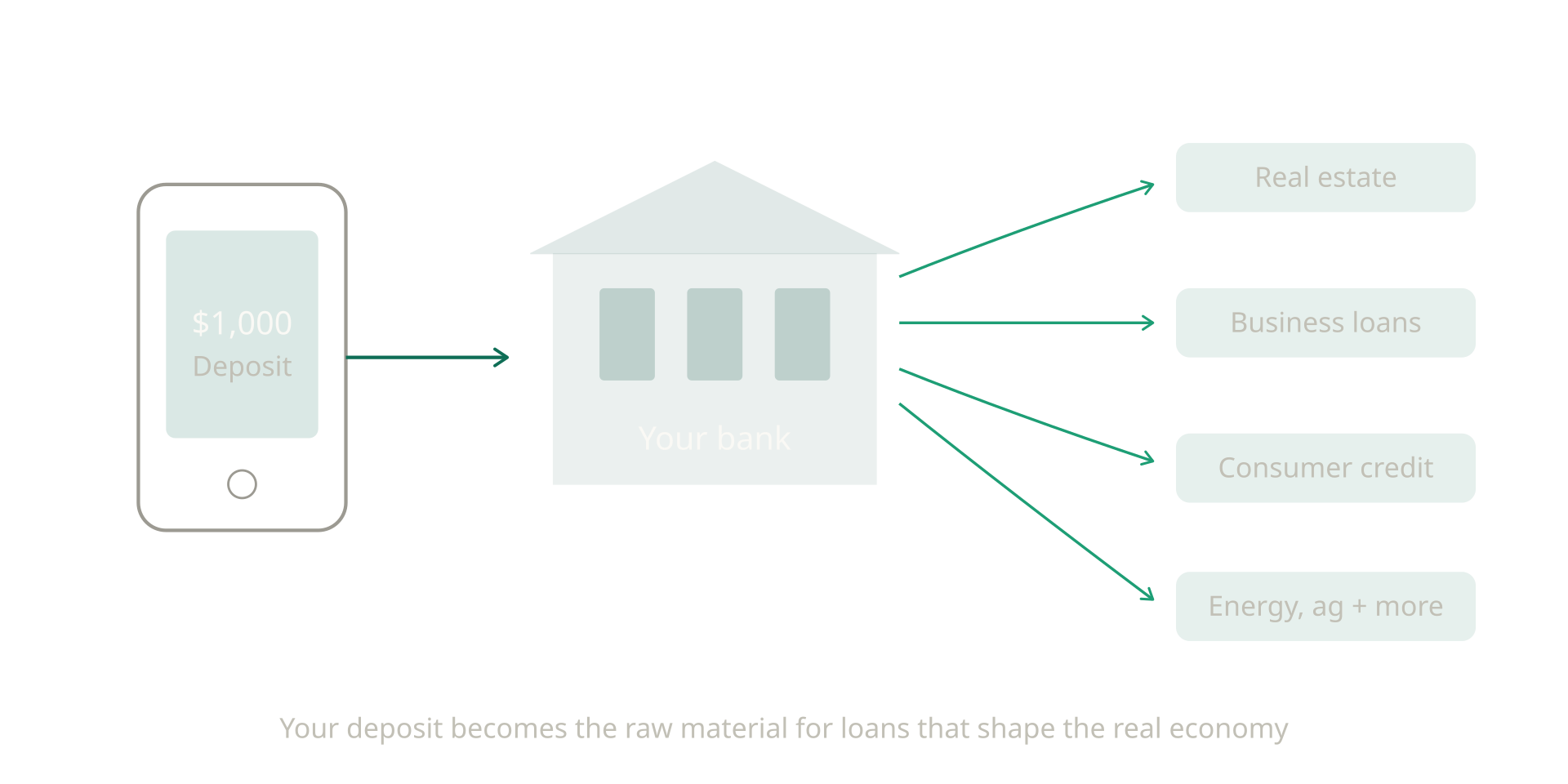
What Actually Happens to Your $1,000 After You Click “Deposit”?
Most people think of a bank deposit as storage; a place where money waits to be used. But that’s not what actually happens inside the financial system.
When you deposit $1,000 into your bank account, that money immediately becomes part of the raw material banks use to make loans. And loans are one of the main instruments determining what gets built, which businesses expand, which homes come to market, which technologies are adopted, and which communities move forward.
According to the Federal Reserve, U.S. banks lend out more than 70% of the deposits they hold (1). With $18.4 trillion sitting in commercial bank accounts (2), that means roughly $13 trillion of customer deposits are in active use, shaping the direction of the real economy. And because lending patterns follow long-standing structural pathways, your $1,000 doesn’t flow into a vacuum; it flows into a highly patterned system.
In practice, deposit flows shape lending, and lending shapes economic, social, and environmental outcomes. So where does your $1,000 actually go?
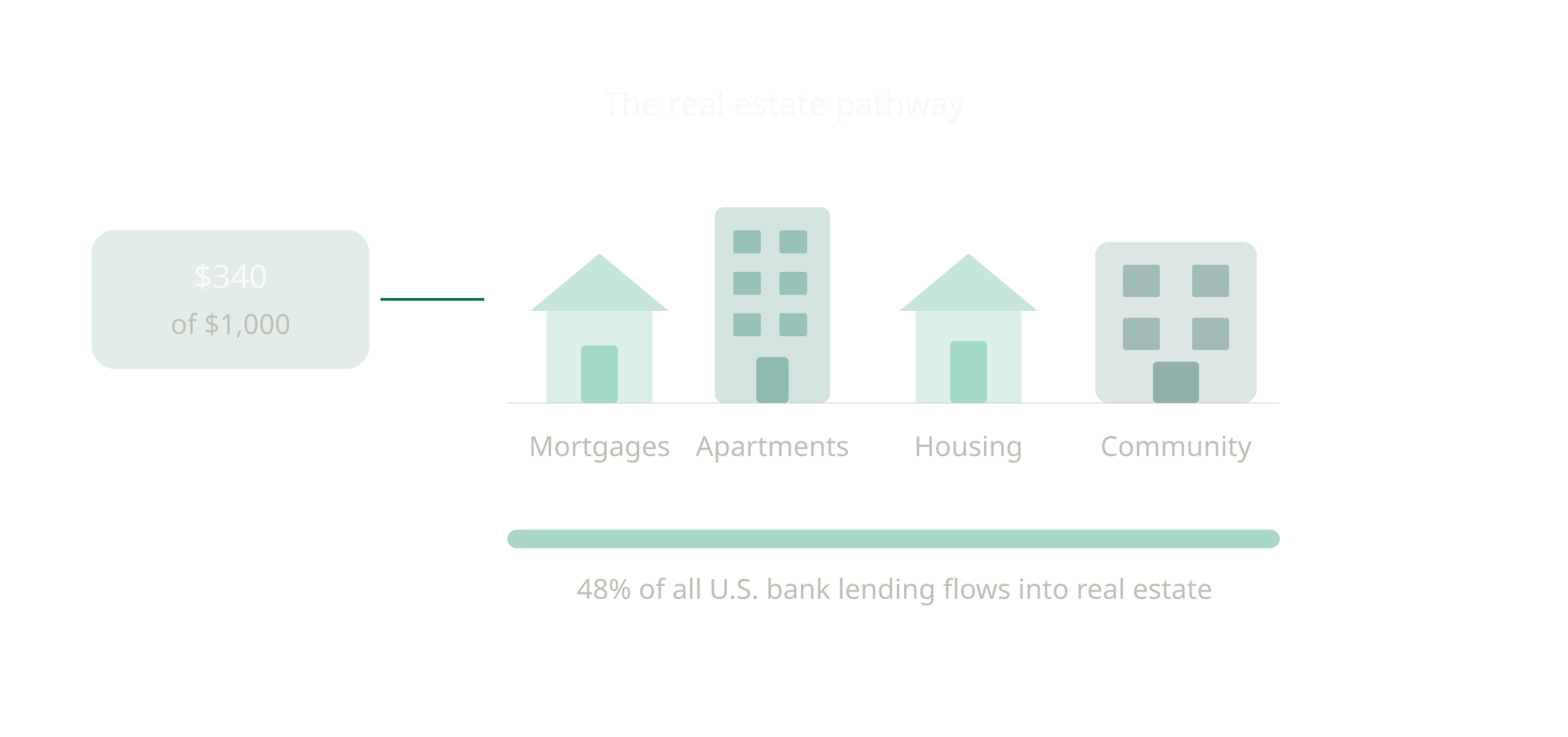
The Real Estate Pathway – Where Nearly Half of Your $1,000 Ends Up
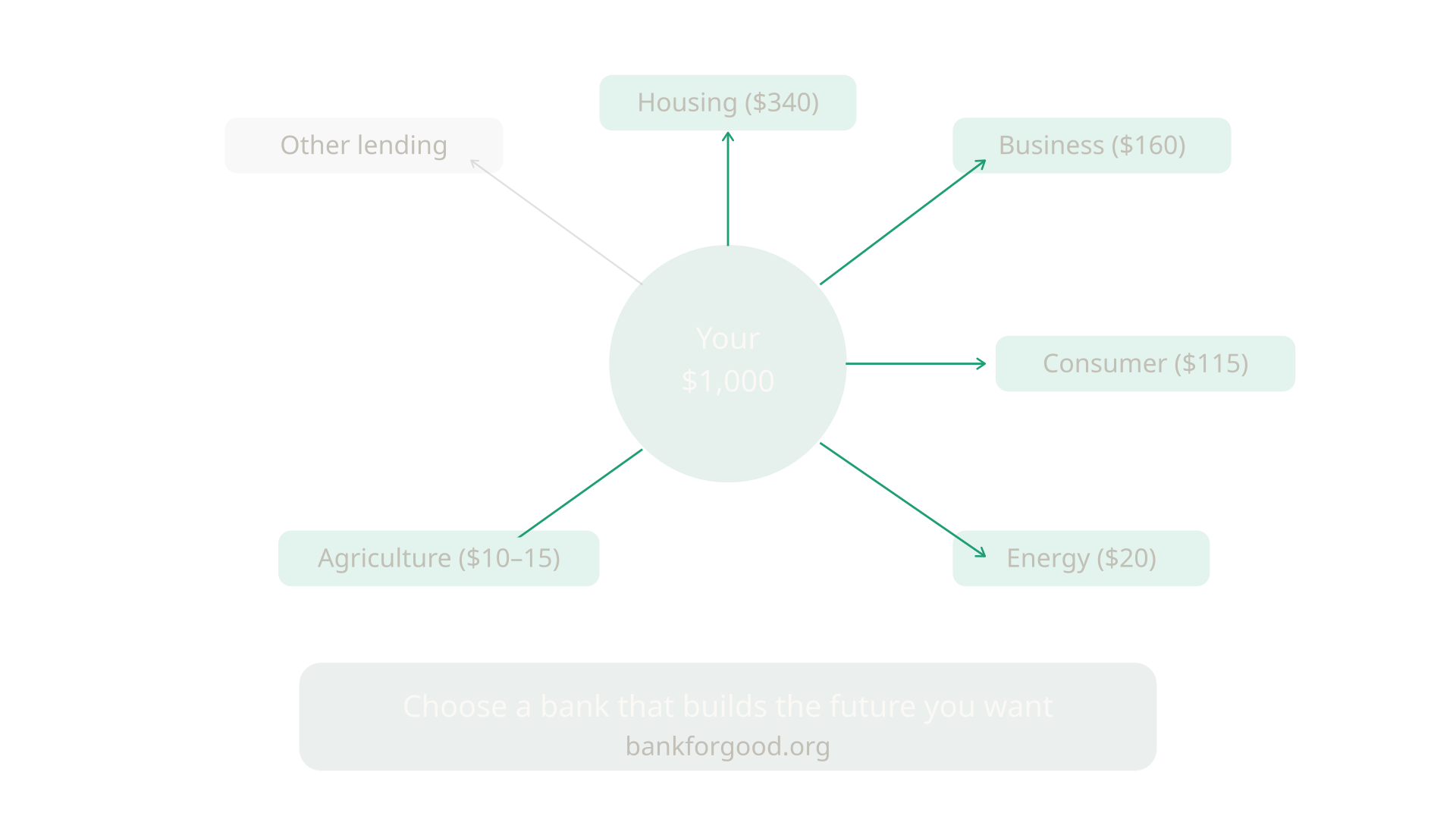
If you deposit $1,000 today, chances are that roughly $340 of it is eventually transformed into some form of real estate credit. Real estate lending is about $5.7 trillion nationwide, 48% of total lending (3), and it remains the single largest destination for bank credit.
And this has consequences: it influences housing construction, home prices, urban development, rental markets, and the physical shape of communities. Your $1,000 may help finance a mortgage, a small apartment building, a community center, or a downtown passive housing redevelopment depending on your banks’ loaning priorities.
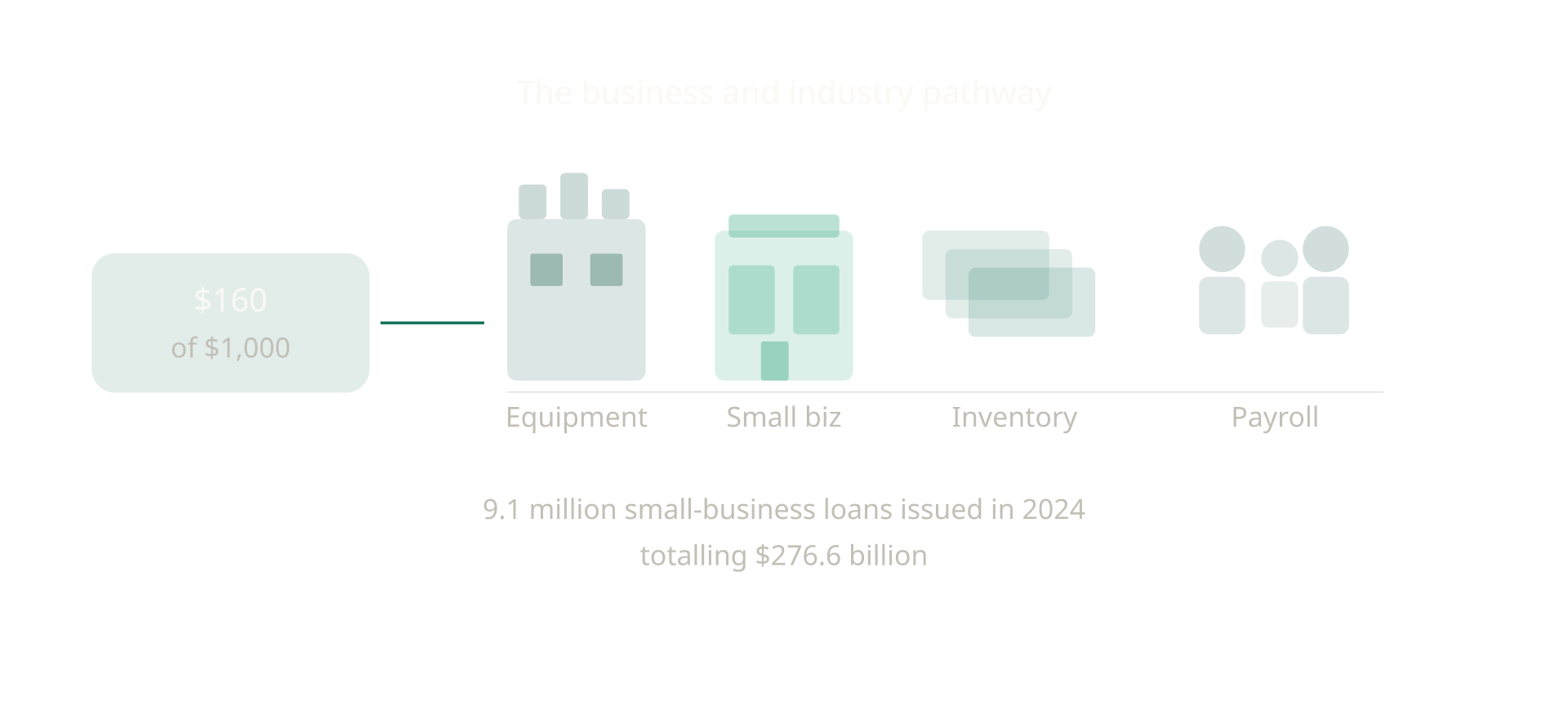
The Business & Industry Pathway – Approximately $160 of Your $1,000
Roughly one-fifth of all bank lending becomes Commercial & Industrial (C&I) credit i.e., the loans that help businesses grow (4).
If you deposit $1,000, about $160 of that portion is likely to end up flowing into a loan that supports new equipment, inventory, payroll, factories construction and maintenance, supply chain development, energy and grid infrastructure and local business expansion. In 2024 alone, U.S. banks issued 9.1 million small-business loans, totaling $276.6 billion (5).
These flows shape entrepreneurship, employment, and local economic opportunity. Your $1,000 may be part of the capital that keeps a restaurant open, helps a manufacturer upgrade machinery, or allows a local business to hire its next employee.
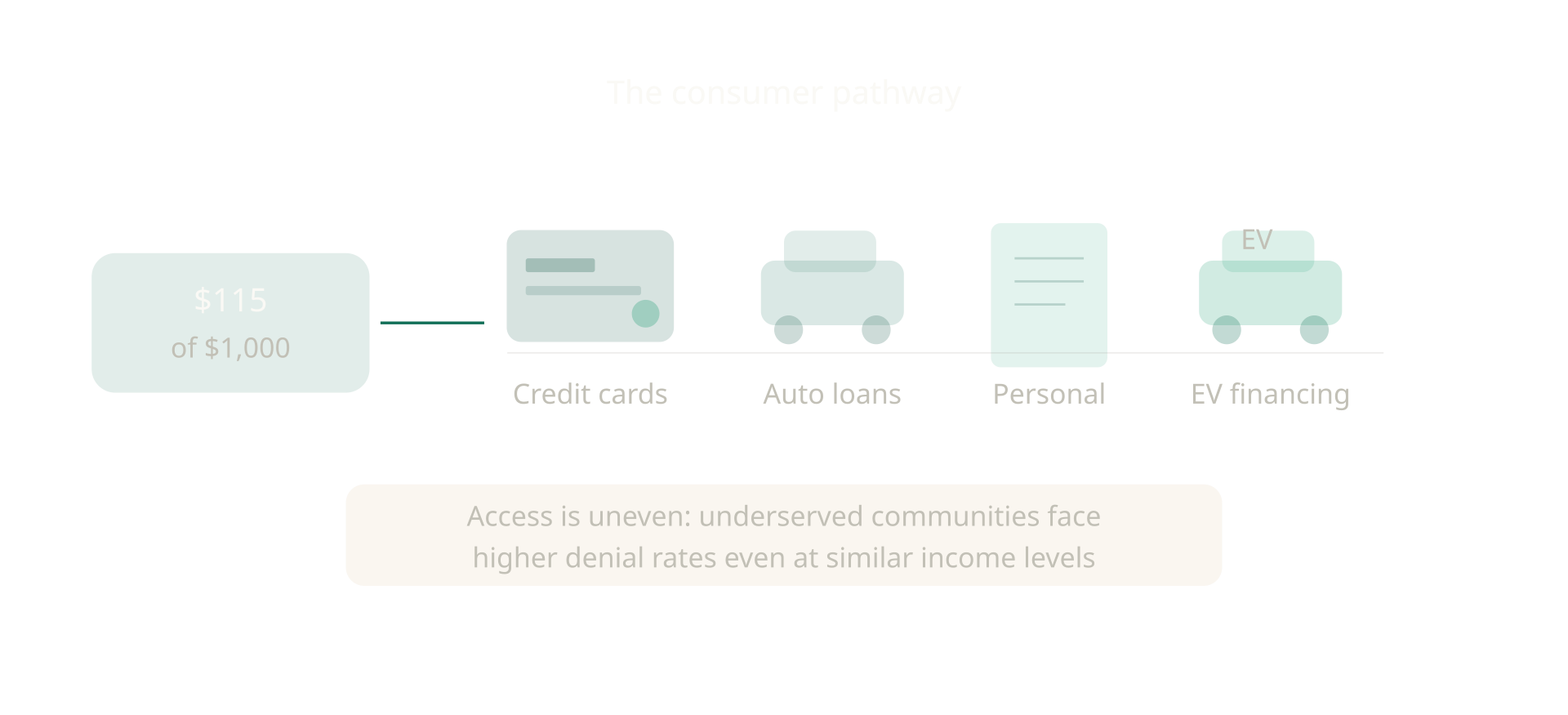
The Consumer Pathway – About $115 of Your $1,000
Consumer credit represents roughly 15–20% of the loans that U.S. commercial banks hold on their balance sheets (6). In the $1,000 story, this means approximately $105–$140 of the deposit-funded lending your bank performs ultimately becomes, credit-card balances, auto-loans, personal loans and other unsecured household credit.
These flows finance essential mobility, household stability, and short-term resilience; all of which are core drivers of U.S. economic activity.
Access to these forms of credit is not evenly distributed though. Research from the Federal Reserve shows that credit outcomes varied by both income level and demographic factors, however applicants from historically underserved communities report higher denial rates even when comparing similar income levels (7).
Although most EV financing in the U.S. still happens through auto-finance companies and leases, commercial banks hold a growing share of EV-related auto loans. And because EV purchases increasingly depend on access to affordable credit, your deposits indirectly influence who is able to adopt electric vehicles. In 2024, 9.3% of all new vehicles purchased in the U.S. were electric, and 38.9% of those were financed through loans (8).
The consumer-credit slice of your $1,000 helps determine who can access electric vehicles and newer transportation options, who can weather financial shocks, and who ends up paying more just to participate in daily life. Ultimately, consumer loans shapes which households gain access to financing that supports stability, opportunity, and access to newer technologies.
The Agricultural Pathway – Only a Few Dollars, But Outsized Impact
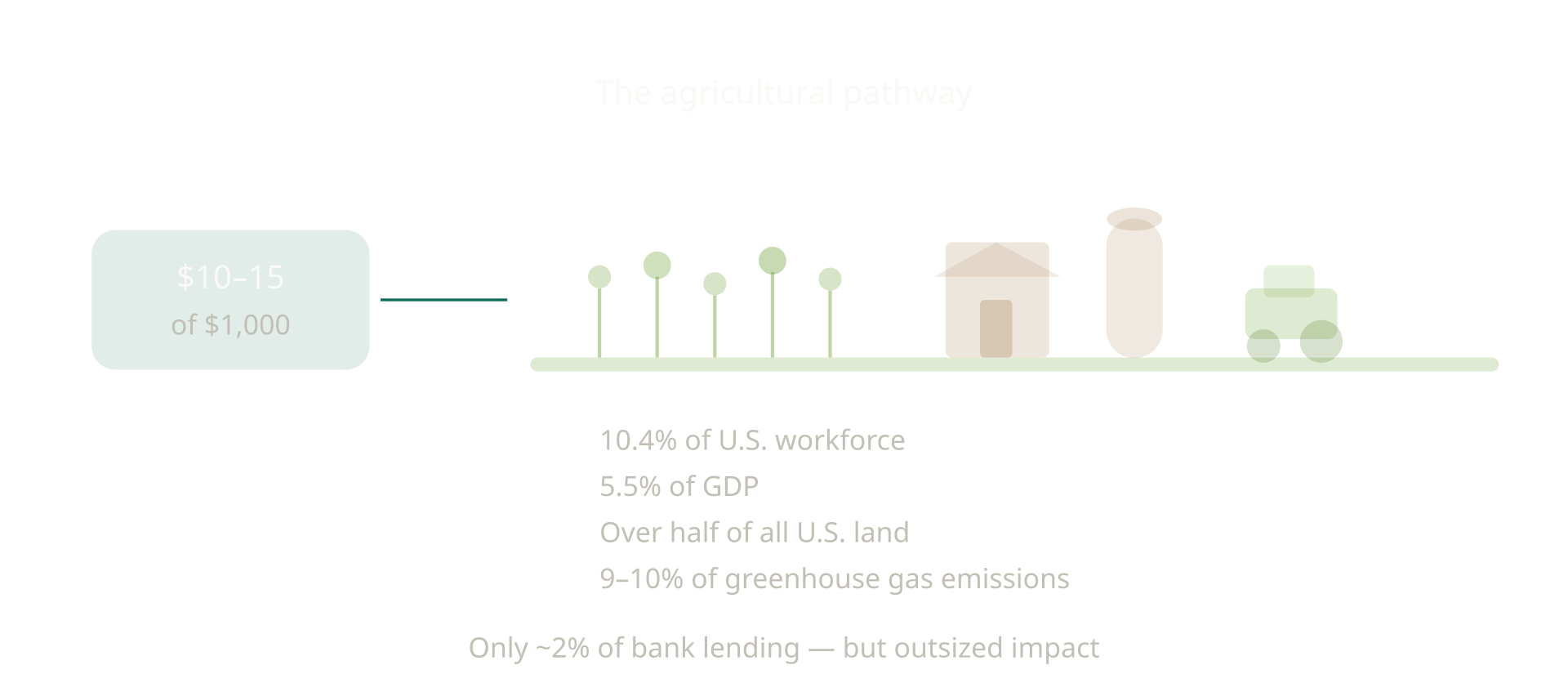
Agriculture receives only ~2% of total bank lending; about $205 billion (8). So from your $1,000 deposit, perhaps only $10–$15 eventually supports U.S. agriculture. But that small flow underpins a sector that, employs 10.4% of the U.S. workforce (9), contributes 5.5% of GDP (9), spans over half of all U.S. land (10) and generates 9–10% of U.S. greenhouse gas emissions (11), making it a significant sector for infrastructure and emissions-related investments
Agricultural loans may be a narrow slice of bank portfolios, but they play a central role in food production, rural economic stability, and the environmental trajectory of millions of acres of working land. Even a few dollars of your deposit help keep that system operating or modernizing.
The Energy Pathway – About $20 of Your $1,000
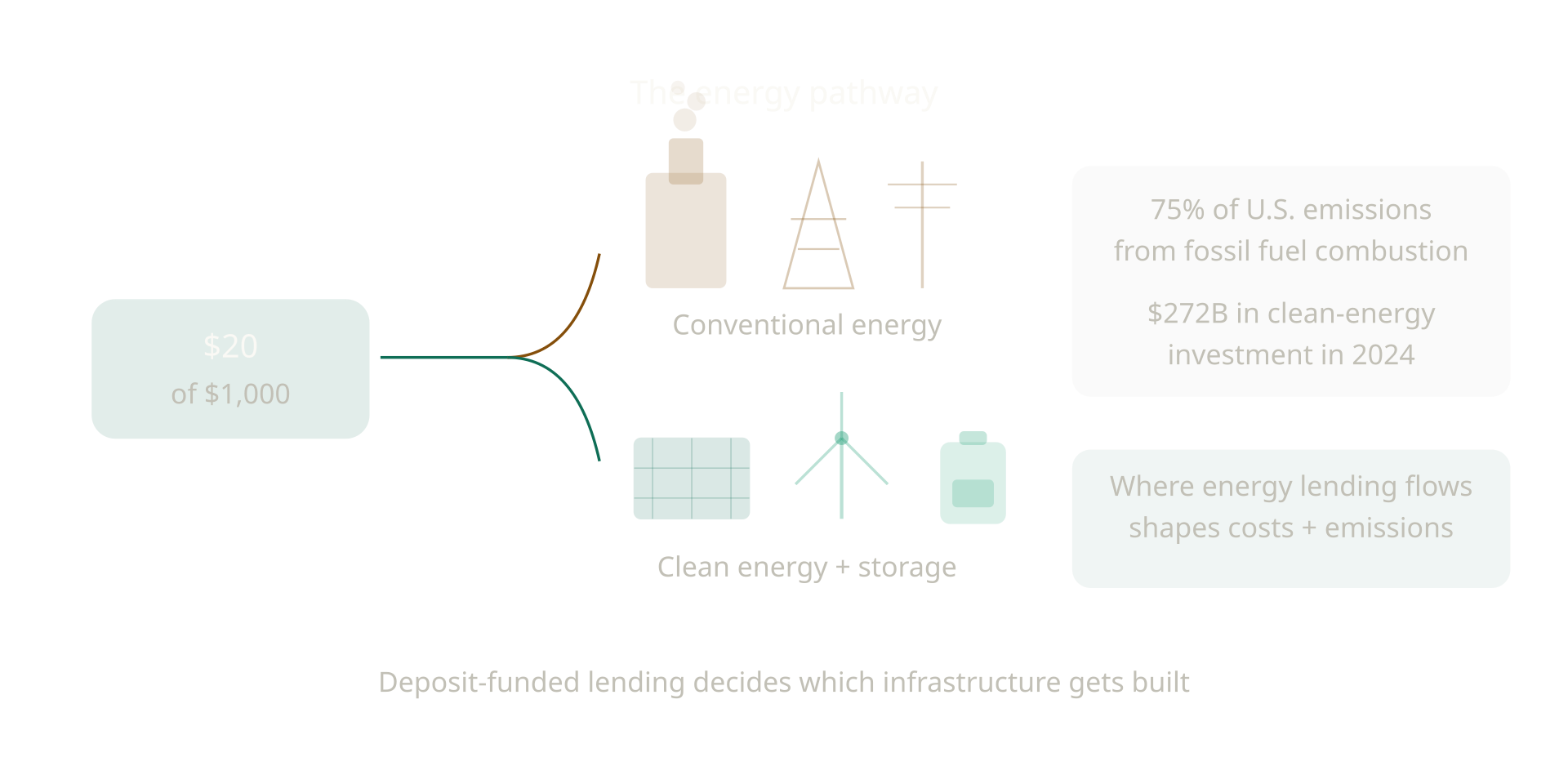
Energy is one of the most capital-intensive parts of the U.S. economy, and therefore a large destination for deposit-funded commercial lending. If you deposit $1,000, roughly $20 of the loaned portion ultimately flows into some part of the energy system including conventional energy infrastructure, regulated utilities, or emerging clean-energy technologies.
Federal Reserve data shows that U.S. banks hold $2.84 trillion in Commercial & Industrial (C&I) loans (5). Although regulators do not publish a granular breakdown of how much of this lending goes to energy borrowers, the best available research indicates that 10–15% of large-bank C&I portfolios are tied to energy-related sectors, including fossil-fuel producers and electric utilities (12). Applied cautiously to the broader system, this implies that $280–$425 billion of outstanding business loans support energy-sector activity.
Bank involvement in the conventional energy system also appears in capital-markets activity. In 2024, U.S. banks participated in $285–$290 billion in fossil-fuel financing (13). Not all of this is deposit-funded lending, but it illustrates how deeply embedded long-lived conventional energy assets remain in financial portfolios.
At the same time, banks are expanding financing for emerging energy technologies. U.S. clean-energy investment reached $272 billion in 2024 (14), and a growing share of that investment is now debt-financed as technologies mature and cash flows stabilize. This includes commercial solar, battery storage, efficient buildings, electrification upgrades, and community-scale energy systems.
Energy lending determines which infrastructure gets built and maintained, with cascading effects on costs, emissions, and community outcomes. Fossil-fuel combustion still accounts for roughly three-quarters of U.S. greenhouse gas emissions, with the power sector contributing about 25% (15). Because banks supply significant capital to this system, deposit-funded lending flows, toward established infrastructure or emerging alternatives, shape energy costs, emissions outcomes, and infrastructure resilience nationwide.
Energy burden: One in four low-income households spends over 15% of income on energy bills, triple the national average, a gap that access to efficiency financing could significantly narrow (16).
Health and economic costs: Air pollution from energy infrastructure contributes to respiratory illness and premature mortality, creating measurable economic burdens through healthcare costs and lost productivity, with impacts concentrated in communities adjacent to older facilities (17).
Technology access: Only 16% of U.S. homes use heat pumps and just 1% use heat-pump water heaters (18), reflecting the upfront capital barriers that limit access to lower-cost, modern heating and cooling systems.
Grid resilience: Underinvestment in grid modernization leads to more frequent and longer outages, particularly in economically vulnerable communities where recovery resources are limited (19). Where grid lending flows determines which neighborhoods gain access to reliable, resilient electricity infrastructure.
Across affordability, grid reliability, air quality, emissions, and access to modern technologies, the flow of deposit-funded lending becomes the flow of opportunity. Even a small share of your $1,000 helps shape the energy systems people depend on every day.
Closing the Loop: What Your $1,000 Ultimately Means
When you step back, the story behind your $1,000 deposit is surprisingly straightforward: it becomes part of the capital that decides what the country builds, maintains, and prioritizes.
It helps determine whether a town gets new housing and at what price, whether a small business can expand, whether farms get the credit they need, whether the grid becomes more reliable, and whether families can access lower-cost technologies that shape long-term living standards.
None of this happens overnight, and none of it is driven by any single person’s deposit. But in the aggregate, deposits are one of the most powerful and most overlooked drivers of economic, social, and environmental outcomes in the United States. And because deposits flow through such predictable channels, your financial choices quietly influence which systems grow, which modernize, and which fall behind.
This leads to a simple, practical takeaway; one of the most meaningful action you can take is to understand how banking works and then choose a bank that aligns with the future you want to support.
This isn’t about purity or pressure. It’s about awareness, transparency, and using one of the easiest levers available to shape real-world outcomes.
That is why Bank for Good exists: to make these systems visible, accessible, and understandable; to help people see where their money goes after it leaves their account; and to provide a clear path toward banking choices that strengthen communities, broaden opportunity, and support a more resilient, future-ready economy.
Your $1,000 doesn’t sit still. It flows into different sectors of the economy. Banking with awareness means understanding those flows. #Banking #FinancialLiteracy #EconomicImpact #SustainableFinance #BankforGood
Note on How Lending Data Works in This Article:
Throughout this analysis, lending figures refer specifically to the loans that commercial banks retain on their balance sheets, as reported in the Federal Reserve’s H.8 release. In practice, banks originate far more credit than they ultimately hold as many loans are later sold, securitized, or transferred to government-sponsored entities or non-bank lenders. This means total credit in the economy is larger than bank-held balances, but the lending pathways described here reflect the portion directly enabled by commercial bank deposits.
REFERENCES
- Fitch Ratings (Oct 2025) – “U.S. Banks Report Strong 3Q25 Earnings; Credit Stable with Isolated Fraud Losses” Link: https://www.fitchratings.com/research/banks/us-banks-report-strong-3q25-earnings-credit-stable-with-isolated-fraud-losses-24-10-2025
- Federal Reserve H.8 Release – “Assets and Liabilities of Commercial Banks in the United States” (Table 2. Assets and Liabilities of Commercial Banks in the United States 1, Seasonally adjusted, billions of dollars. — line 34 “Deposits”)(Nov 2025). Link: https://www.federalreserve.gov/releases/h8/current/default.htm
- Federal Reserve H.8 Release – “Assets and Liabilities of Commercial Banks in the United States” (Table 2. Assets and Liabilities of Commercial Banks in the United States 1, Seasonally adjusted, billions of dollars. — line 11 “Real Estate Loans”)(Nov 2025). Link: https://www.federalreserve.gov/releases/h8/current/default.htm
- Federal Reserve H.8 Release – “Assets and Liabilities of Commercial Banks in the United States” (Table 2. Assets and Liabilities of Commercial Banks in the United States 1, Seasonally adjusted, billions of dollars. — line 10 “Commercial and Industrial Loans”) (Nov 2025). Link: https://www.federalreserve.gov/releases/h8/current/default.htm
- Federal Reserve / FDIC / OCC – “Findings from the 2024 CRA Small Business, Small Farm, and Community Development Lending Data Fact Sheet”(2025). Link: https://www.occ.gov/news-issuances/news-releases/2025/nr-ia-2025-107b.pdf
- Federal Reserve H.8 Release – “Assets and Liabilities of Commercial Banks in the United States” (Table 2. Assets and Liabilities of Commercial Banks in the United States 1, Seasonally adjusted, billions of dollars. — line 20 “Consumer Loans”)(Nov 2025). Link: https://www.federalreserve.gov/releases/h8/current/default.htm
- Board of Governors of the Federal Reserve System — Economic Well-Being of U.S. Households in 2023, Section 5: Banking and Credit (May 2024). Link: https://www.federalreserve.gov/publications/2024-economic-well-being-of-us-households-in-2023-banking-credit.htm
- Experian plc — “State of the Automotive Finance Market Report: Q4 2024” (2025). Link: https://www.experian.com/blogs/insights/auto-the-current-state-of-ev-financing-why-more-consumers-are-choosing-leasing/
- United States Department of Agriculture, Economic Research Service (USDA ERS) – “Ag and Food Sectors and the Economy” (2024). Link:https://www.ers.usda.gov/data-products/ag-and-food-statistics-charting-the-essentials/ag-and-food-sectors-and-the-economy/
- USDA ERS – “Major Land Uses” (2022). Link: https://www.ers.usda.gov/data-products/major-land-uses/
United States Environmental Protection Agency (EPA) “Sources of Greenhouse Gas Emissions: Agriculture Sector Emissions” (2022). Link: https://www.epa.gov/ghgemissions/agriculture-sector-emissions - International Review of Financial Analysis – “Climate transition risk in U.S. loan portfolios: Are all banks the same?” (2023). Link: https://www.sciencedirect.com/science/article/abs/pii/S1057521922003519
Rainforest Action Network et al. – ‘Banking on Climate Chaos 2025: Fossil Fuel Finance Report’ (2025). Link: https://www.bankingonclimatechaos.org - Clean Investment Monitor – Q4 2024 Update (2024). Link:https://cdn.prod.website-files.com/64e31ae6c5fd44b10ff405a7/681a5f71393040f8a650ce77_Clean%20Investment%20Monitor_Q4%202024%2002%20Update.pdf
- U.S. Energy Information Administration (EIA) — “Where Greenhouse Gases Come From” (2024). Link: https://www.eia.gov/energyexplained/energy-and-the-environment/where-greenhouse-gases-come-from.php
- American Council for an Energy-Efficient Economy (ACEEE) ( “Energy Burden in the United States” (2024). Link: https://www.aceee.org/energy-burden
- Natural Resources Defense Council (NRDC), Medical Society Consortium on Climate & Health, Wisconsin Health Professionals for Climate Action — “The Costs of Inaction: The Economic Burden of Fossil Fuels and Climate Change on Health in the United States” (2021). Link: https://www.nrdc.org/resources/costs-inaction-economic-burden-fossil-fuels-and-climate-change-health-us
- Rewiring America – “Pace of Progress: The first-ever report identifying the residential electrification adoption rates required to meet U.S. climate commitments” (June 2023, updated December 2023). Link: https://www.rewiringamerica.org/research/pace-of-progress-home-electrification-transition
- Ezzati, F. et al. — “Power outage-risk integrated social vulnerability analysis highlights disparities in small residential communities” (2025). Link: https://doi.org/10.1038/s43247-025-02278-1


